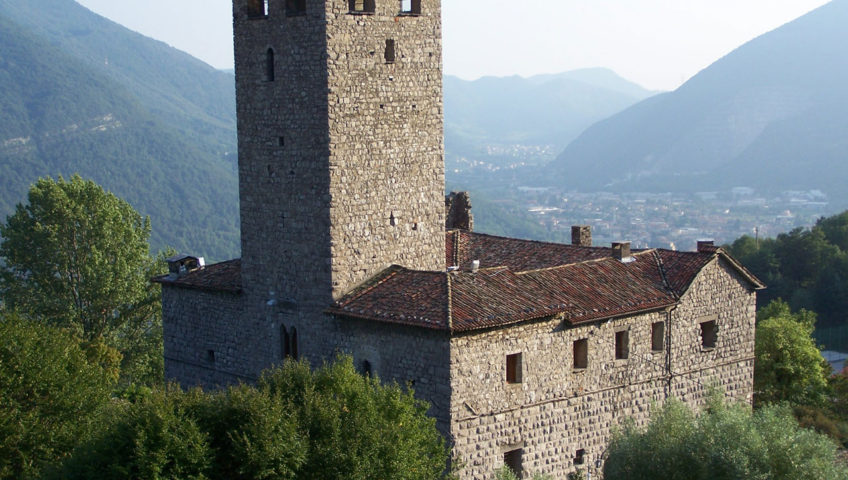
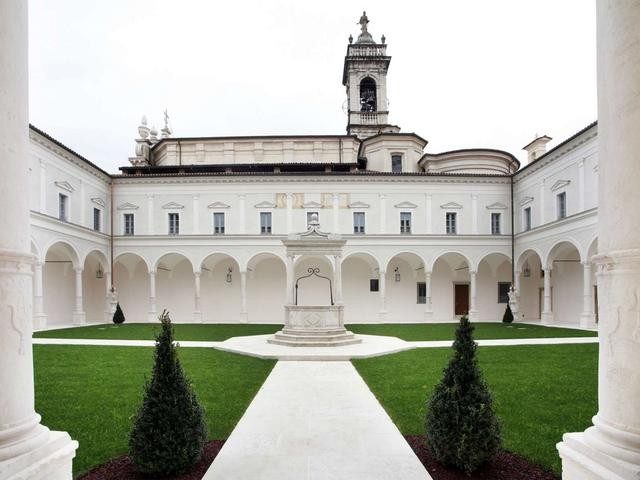
San Paolo Abbey

The foundation of the Abbey of San Paolo d’Argon dates back to May 19, 1079 when Giselberto, belonging to one side of the Counts of Bergamo, stipulates the act of donation to the monastery of San Pietro in Cluny, of the land adjacent to the mountain of Argon, that they should erect a monastery dedicated to the Apostles Peter and Paul. The monastery is built in a short time, so that the first evidence of his presence are of the 1092 .
After a period of relative decline during the fourteenth century, in 1466, by order of Pope Paul II, the monastery is given in commendam to Giovanni Battista Colleoni, grandson of the leader Bartolomeo, that two decades later, however, waiver of the benefit of the regime and offers the convent to the Congregation of Santa Giustina of Padua (called a few years later Cassinese). The annexation is enshrined May 14, 1496 by a bull of Alexander VII which also states that the superior of the monastery deserves the title of Abbot .
The new monks commit soon to renovate the building, which preserves the structure until 1512, the first reconstruction. With this renovation the small cloister was born, admirable for the perfect Renaissance proportions, the elegance of terracotta decorations and refinement of the capitals of the columns: all elements that suggest the name of the greatest architect from Bergamo Pietro Isabello (or Cleri) said Abano , which is responsible for security successive rooms of the building.
The Abbot Gregory of Mantova commissioned between 1532 and 1536, to Isabello  the refectory of the community which opens on the southern side of the cloister, transformed in the ‘900 into a chapel.
The initial project was a square design with 40 columns. The present form, with 32 columns and rectangular shape, has been established at the time of edification, which occurred during the abbot Cassiodorus of Novara (1536-1540). The abbot Fulgenzio from Mantua, at the head of the monastery from 1599 to 1602, decided to build on the side South – East of the great cloister a new refectory, intended to replace that of the minor cloister, whose architect is unknown.
Between 1608 and 1613 the main courtyard of the monastery is completed with the construction of the eastern part: there are three large rooms including the Chapterhouse. In the following years the most significant involvement is due to the abbot Barbisoni of Brescia who, between 1624 and 1627, decided to decorate the top low arch of the new refectory by the Veronese artist Giovanni Battista Lorenzetti.
On June 6 1797, Napoleon Bonaparte, encamped in Mombello, issues an ordinance that leads to the suppression of the monastery. The assets are confiscated by the Hospital of Bergamo.
Reduced to a farmhouse, in 1935 the monastery was purchased by the couple Giovanni e Luigina Prometti who gave it as a gift to the Bishop Adriano Bernareggi who will destine the main body to the Patronato San Vincenzo of Don BepoVavassori.
In 1978 the complex becomes a Spirituality Center.
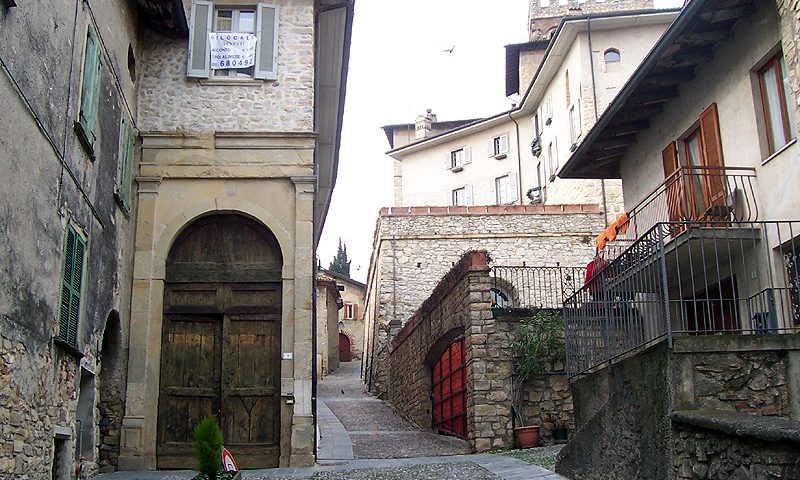
Castle and Borough of Costa di Mezzate

The castle of Costa di Mezzate, built around 1000, is located in the homonymous municipality, a small town about 10 kilometers from Bergamo. The first documentary evidence of the existence of the castle dates back to 1160.

The castle, built by the Emperor Ottone I, was purchased later by Alberto degli Albertoni from the Capitani of Vertova, the representative of the Lombard League in Lodi, signer of the Peace of Constance and counselor of Bergamo in 1190.

In the following centuries the castle became a target of the expansionist ambitions of Bernabo Visconti, Duke of Milan, but who failed to violate the fortifications.

In 1433, a decree was issued by the Republic of Venice, which exempted for five years from any real load, personnel et mixed those from Bagnatica et Mezzate in recognition of their loyalty et in recognition of the misfortunes suffered “.

In the following centuries, the castle was used as a residence of Camozzi-Vertova family, the current owners.

Places of San Giovanni XXIII

Sotto il Monte Giovanni XXIII is located at the Northern part of Bergamo and bordered by the foothills of  Mount Canto,  about 18 Kilometers to the west of the capital orobico.

A great part of the places of interest concern the places where Pope John XXIII was born and lived, a Pilgrimage and popular devotion destination.

Chiesa di Santa Maria

The church of Santa Maria, where the little Angelo Roncalli was baptized, and a few years later he even celebrated celebrated his first mass. Dating from the XV century it preserves paintings and frescoes of great value.

Chiesa di San Giovanni Battista

The church of San Giovanni Battista, dates back from the early twentieth century. Inside it you can admire numerous eighteenth century frescoes and other from Bartolomeo Nazari and Francis Chapel which were originally placed in the old parish, and an imposing processional statue of the Madonna.

Cappella di Maria Regina della pace

The Chapel of Mary Queen of Peace was consecrated in 1976. This presents an altar originating from the Ancient Basilica of St. Peter in the Vatican, and a polychrome inlay depicting Pope John XXIII, a charming work from artist Andrea Gusmai.

Abbazia rettoria di Sant’Egidio in Fontanella

The Sant’Egidio Abbey, built in the locality of Fontanella in the tenth century in Romanesque style, is one of the best preserved medieval buildings in the whole province. Inside you can find frescoes and paintings of excellent workmanship dating between the twelfth and fifteenth centuries.

Bianzano Castle

A rampant lion and an eagle from the large claws that bites a prey stand out in the emblem of the ancient and noble family Suardi, painted on the entrance door to the Castle of Bianzano.
Dating back to the thirteenth century, the complex has a perfectly square plant, with the diagonals oriented towards the four cardinal points.
Located on a plateau and in a dominant position on the western side of the Cavallina Valley, it permited to control the north west and north east sides from where potential enemies could arrive: the road coming from the Val Seriana through the Red Valley and the one that linked Bergamo with Lake Iseo and Val Camonica. In addition it offered a great view of Lake Endine and Mount Torrezzo.

Curiosity

Every year on the first weekend of August, the castle is home to a historical re-enactment that involves a highly important event: in 1367 Giovanni, belonging to Suardi family, married the daughter of Bernarda Bernabo Visconti, ruler of the Duchy of Milan, receiving as a gift the castle itself.

After the restoration around 1960/70, the building is in good structural conditions; It is a summer residence of the owners and the whole year is inhabited by a couple of tenants / guardians in the mezzanine floor at the entrance of the tower.

Guided visit

MAY – OCTOBER
22 MAY
26 JUNE
19 JULY
7 AUGUST
11 SEPTEMBER
23 OCTOBER

Request a visit calling +39 035814001 or send a mail to cortedeisuardo@gmail.com